Teaching
Teaching portfolio of Jianqing Jia
Feel free to explore the sections on my background, detailed curriculum vitae, and my journey in teaching and research.
Personal statement for OTA award

I am honored to be considered for the Outstanding TA Award, a recognition that signifies not just my commitment to teaching and research, but also the impact I hope to have on my students' academic and personal growth.
My journey at Syracuse University has been a transformative experience, shaping me into a more effective educator and researcher. The diverse environment and the vibrant academic community have provided me with invaluable opportunities to refine my teaching methodologies and to engage with students from various backgrounds. These experiences have not only enriched my understanding of effective pedagogy but have also reinforced my commitment to fostering an inclusive and supportive learning atmosphere.
I invite you to read my detailed Personal Statement here, where I discuss my teaching experiences, my approach to student engagement, and the methodologies I employ to facilitate meaningful learning experiences. The statement further outlines the values and strategies that underpin my commitment to education and mentorship, reflecting my belief in the transformative power of learning..
Teaching philosophy
As an educator, my journey began at Hebei Normal University, a place renowned for its commitment to nurturing teachers. This background laid the foundation for my philosophy in teaching mathematics, where I emphasize not only the mastery of theoretical concepts but also their practical application. At Syracuse University, my role as an instructor has allowed me to refine my teaching strategies and mentorship, impacting students' learning experiences positively.
Central to my teaching philosophy is the belief that education should empower students to develop independent and critical thinking skills. Inspired by the Chinese proverb, "Give a man a fish and you feed him for a day; teach a man to fish and you feed him for a lifetime," I strive to create a learning environment that fosters curiosity, encourages active participation, and nurtures lifelong learning. My approach is student-centered, focusing on engagement, personalization, and practice to meet diverse learning needs and styles.
In my comprehensive teaching philosophy document, I delve deeper into how these principles are applied in practice, illustrating my commitment to a supportive, inclusive, and equitable learning environment. From engagement strategies that ignite interest and foster understanding to personalized approaches that cater to individual learning styles, I detail the methods I employ to ensure that every student feels valued and empowered. Additionally, I discuss the importance of practice in solidifying understanding and building confidence.
I invite you to explore my full Teaching Philosophy here, where I further elaborate on these concepts and share my experiences and strategies for effective teaching. This document reflects my dedication to not only imparting knowledge but also mentoring students to become confident, resilient, and independent thinkers equipped to navigate the challenges of our complex world.
Teaching summary
Here, you'll find concise summaries of the courses I've taught, showcasing my instructional approaches and the diverse subjects I've covered. Each section reflects my commitment to educational excellence and student success, highlighting key teaching strategies and course outcomes.
In addition, this section provides access to a wealth of teaching materials, including syllabi, exams, quizzes, assignments, which illustrate the structure and content of the course. You will also find quantitative evaluation forms from students, offering insights into their learning experiences and the effectiveness of my teaching. Alongside these resources, I share a short reflective statements on these teaching experiences, highlighting my ongoing efforts to enhance educational outcomes and student engagement, and a detailed reflective statements on evaluations can be found in a separate section below.
Dive into the course details of my teaching journey below.
Syracuse University
Life Sciences Calculus I
S'24, F'23, S'23, F'22, F'21: Instructor of Record
- This is the first course in a two-course, terminal calculus sequence, MAT285-286. It is designed to introduce students to the beauty and power of calculus. Applications to life sciences are emphasized.
- Main concepts: Functions and their graphs, derivatives and their applications, differentiation techniques, the exponential and logarithm functions, integration.
- Comments: I've had the privilege of teaching MAT 285 across multiple semesters. Each iteration has allowed me to refine and enhance the course materials based on student feedback and evaluations. The improvements are evident in the evolving nature of the course content and the increasingly positive responses from students. Below, you can explore how these changes have positively impacted the learning experience over time.
- — Spring 2024 (current): Section M003, 25 students
- — Fall 2023: Section M006, 26 students
- — Spring 2023: Section M009, 28 students
- — Fall 2022: Section M010 & M011, 52 students
- — Fall 2021: Section M002 & M003, 53 students
Elementary Probability and Statistics II
S'22: Instructor of Record
- This is the second course in the probability and statistics sequence, MAT221-222, designed for various academic majors. The primary objectives of the course are to understand basic concepts of statistical inference and to learn commonly used statistical methods of inference.
- Main concepts: Estimation and hypothesis testing, inferences involving two populations, chi-square tests, regression analysis, and analysis of variance.
- Comments: I guided students through complex statistical concepts and their practical applications. This course not only emphasized theoretical understanding but also focused on real-world data analysis, enhancing students' statistical proficiency and analytical skills.
- — Spring 2022: Section M004, 25 students
Business Calculus
Summer'21: Instructor of Record
- One-variable differential and integral calculus. Applications to business and economics.
- Main concepts: Functions, equations and inequalities, limits and derivatives, differentiation and integration techniques, application in economics.
- Comments: I adapted the curriculum to fit an accelerated, virtual format. This course provided students with a comprehensive understanding of business calculus principles, tailored for the online learning environment, ensuring an engaging and thorough educational experience despite the condensed timeframe.
- — Summer 2021: Section M001, 19 students
Life Sciences Calculus II
S'21: Instructor of Record
- This is the first course in a two-course, terminal calculus sequence, MAT285-286. It is designed to introduce students to the beauty and power of calculus. Applications to life sciences are emphasized.
- Main concepts: Integration, areas and volumes, double integrals and differential equations..
- Comments: In Spring 2021, I embarked on my first teaching venture at Syracuse University as the Instructor of Record for MAT 286, navigating the complexities of teaching in a non-native language. This experience was not only a significant professional milestone but also an opportunity to engage with diverse student perspectives in the realm of life sciences calculus.
- — Spring 2021: Section M002, 23 students
Probability and Statistics for the Liberal Arts I
F'20, F'19: Teaching assistant
- As teaching assistant of this course, I hold lab tutorials and recitations every week. My work also includes write and grade worksheets; proctor and grade exams.
- Comments: In my role as a Teaching Assistant for MAT 121, some classes were scheduled for 8 am, challenging both for students and myself. Recognizing this, I implemented strategies to enhance engagement and focus, such as interactive lab tutorials and practical recitations, to help students overcome the early morning sluggishness and actively participate in learning.
- — Fall 2020: Section M101 & M102 & M103 & M104 & M107, 114 students
- — Fall 2019: Section M101 & M102 & M201 & M202, 88 students
Probability and Statistics for the Liberal Arts II
S'20: Teaching assistant
- As teaching assistant of this course, I hold lab tutorials and recitations every week. My work also includes write and grade worksheets; proctor and grade exams.
- Comments: As a Teaching Assistant for MAT 122, the semester was unprecedented due to the onset of Covid-19, resulting in a sudden shift to online instruction. I adapted quickly to these changes, holding weekly lab tutorials and recitations virtually to maintain continuity in learning. My efforts extended to reformatting worksheets for online submission and altering exam proctoring methods to suit the new environment, ensuring students remained supported and engaged during this challenging transition.
- — Spring 2020: Section M101 & M108 & M207, 69 students
Evaluations and reflective statement
At the end of each semester, I look forward to reviewing my teaching evaluations, a process that brings immense excitement and satisfaction. The positive feedback from my students not only affirms my dedication to their academic success but also inspires me to continuously enhance my teaching strategies. This reflective section encapsulates my journey of educational growth, detailing how student evaluations have shaped my pedagogical improvements.
Spring 2021: MAT 286 Life Sciences Calculus II
My teaching journey in Syracuse University as an instructor of record starts from Spring 2021 during the tail end of the Covid pandemic. This unique time meant adapting to hybrid teaching, blending in-person and online instruction from pure online classes.
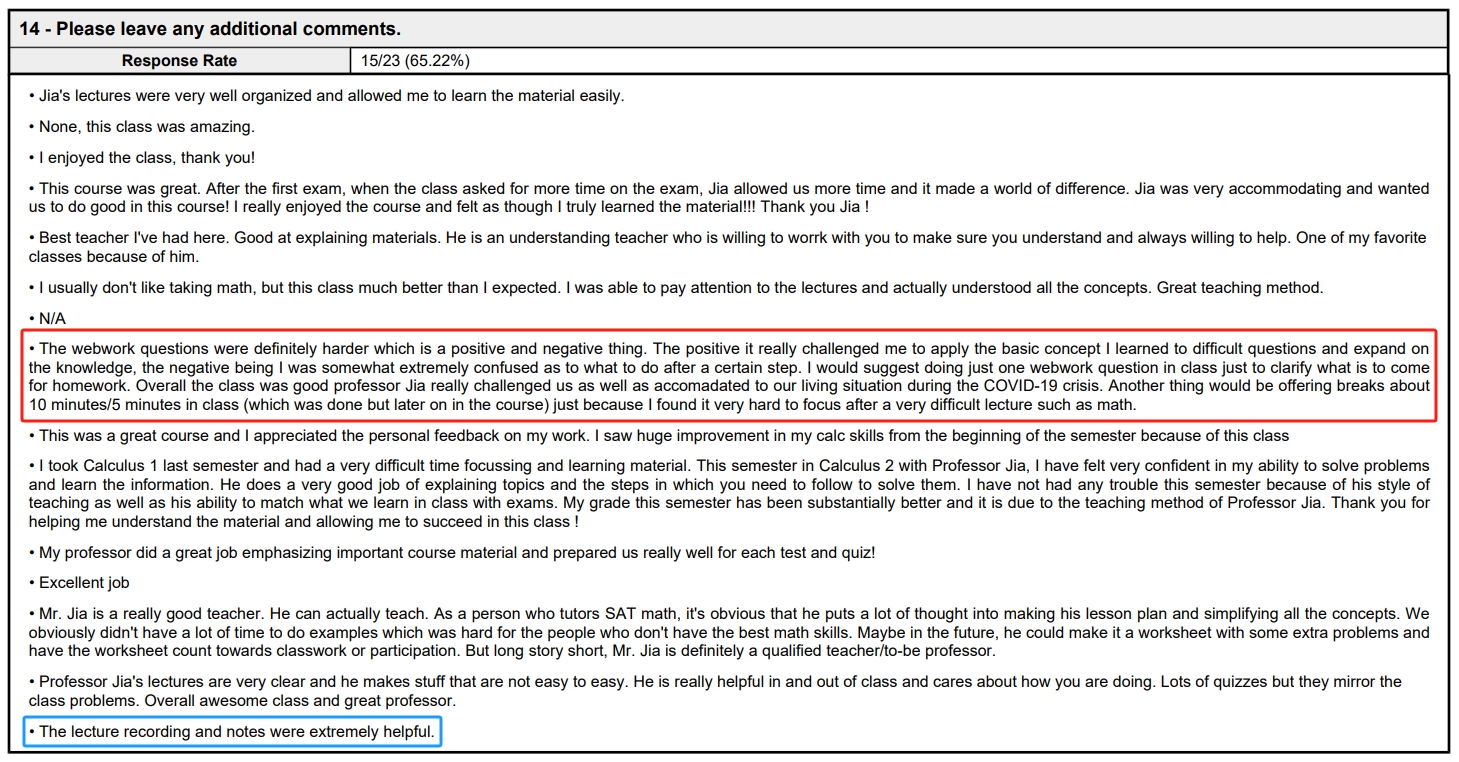
I was thrilled to see the positive feedback from my teaching evaluations. Teaching my first course in a non-native language and achieving such positive student responses marked a significant personal victory. In response to the hybrid teaching model (both in-person and online), I provided all lecture recordings and notes, which, according to student feedback, were highly appreciated for their review value.
I noticed a challenge: the lengthy one-hour and twenty-minute math lectures seemed to strain undergrad students' attention spans. Mid-semester, I introduced short breaks featuring engaging videos or moments for meditation, which evaluations later confirmed as a beneficial change. I've proudly carried this practice into all future courses.
However, I overlooked feedback regarding the WeBwork system's user-friendliness: students think the WeBwork system is not user-friendly. At the time, I didn't grasp the impact of this issue, a realization that would come to affect subsequent semesters. I thought that "deciding which homework system is beyond my control". You can see this ongoing story below, and it underscores the learning curve we all navigate as educators.
Fall 2021: MAT 285 Life Sciences Calculus I
After the experience of MAT 286, I was assigend to teach MAT 285, which appeared to be a easier task initially. However, managing two sections with a total of 53 students presented a new set of challenges, especially with grading quizzes and exams, which became more time-consuming. The back-to-back lectures left me exhausted by the end of the day.
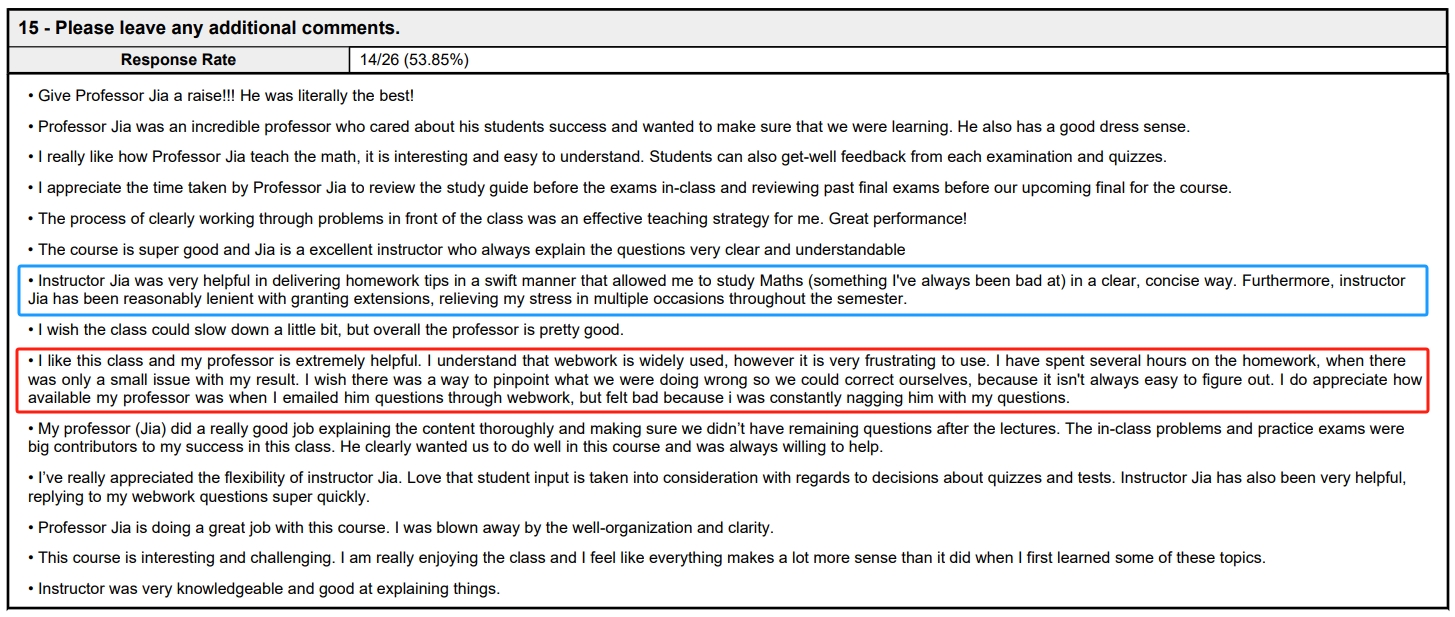
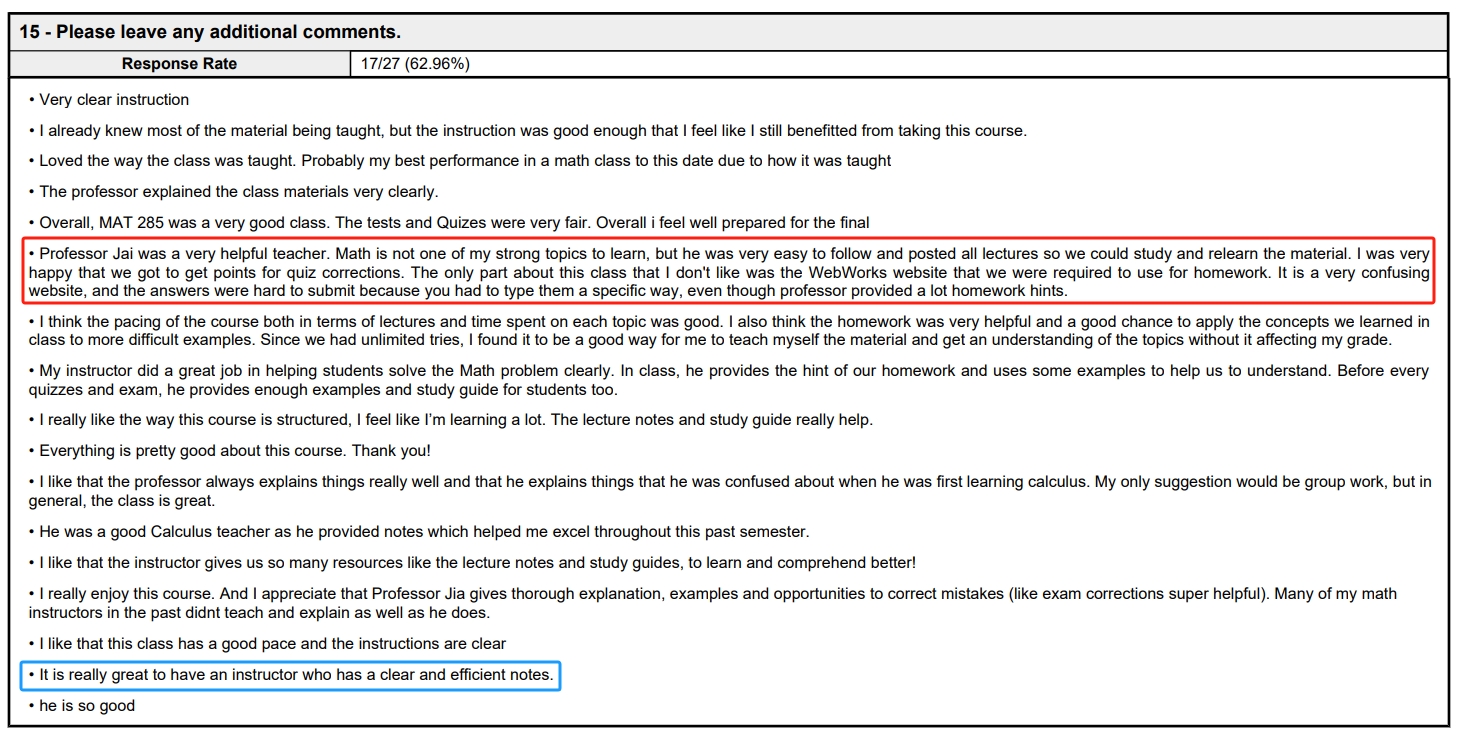
The positive feedback continued with MAT 285, motivating me to maintain effective teaching strategies such as detailed examples and sharing lecture notes. To address reduced class attendance, I shifted from posting all lecture recordings to providing them upon request, encouraging actual lecture participation. This approach seemed to foster better class engagement, steering students away from overreliance on recordings and towards more active learning and attendance.
Continuing from the previous story, I noted additional student concerns about the WeBWork system in MAT 285. This revealed an essential insight: unlike my previous MAT 286 students, who had a semester's experience with WeBWork, the MAT 285 cohort lacked this familiarity, leading to challenges in inputting mathematical formulas correctly. Recognizing this, I resolved to take proactive steps to assist future students with WeBWork, aiming to smooth their learning journey and minimize similar obstacles.
Spring 2022: MAT 222 Elementary Probability and Statistics II
I really enjoy the MAT 222 material; it's not only practical but also very relevant, both in academic research and everyday scenarios. The students in this course, selected through a placement test, usually have a solid background in math and statistics. This makes the class especially engaging and dynamic. I find each lecture enjoyable as students are self-motivated and participate actively, making the teaching experience particularly rewarding for me.
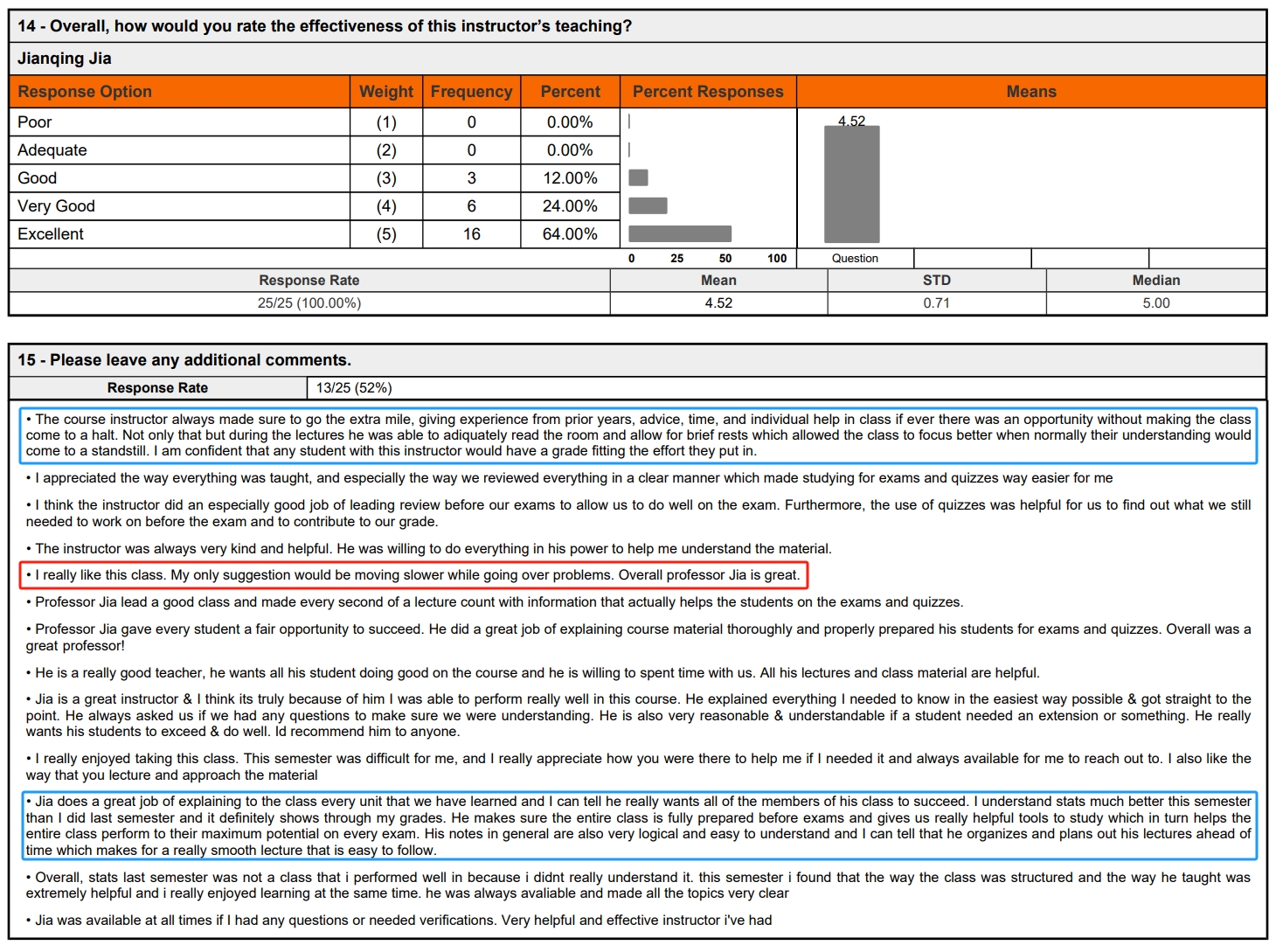
I felt confident in my lecture series for MAT 222, which was reflected in the mostly positive evaluations. The course demands a blend of teaching theoretical statistics and practical software application, making the standard lecture time seem short. I invested considerable effort in preparing each lecture to ensure they were comprehensive and fluid. It's gratifying to see that students recognized and appreciated my thorough preparation, reflecting the hard work invested in the course. Most of the efforts that we put into the course could be seen by the students.
Starting this semester, the teaching evaluation form added a question about my teaching effectiveness. Most students rated me well above average. One student suggested I slow down when solving problems, leading me to focus on pacing in future lectures. My aim for the next semester is to find a better balance, ensuring all students can follow along comfortably.
Fall 2022: MAT 285 Life Sciences Calculus I
Teaching MAT 285 for the second time, I found that conducting two consecutive lectures became significantly more manageable due to my prior experience.
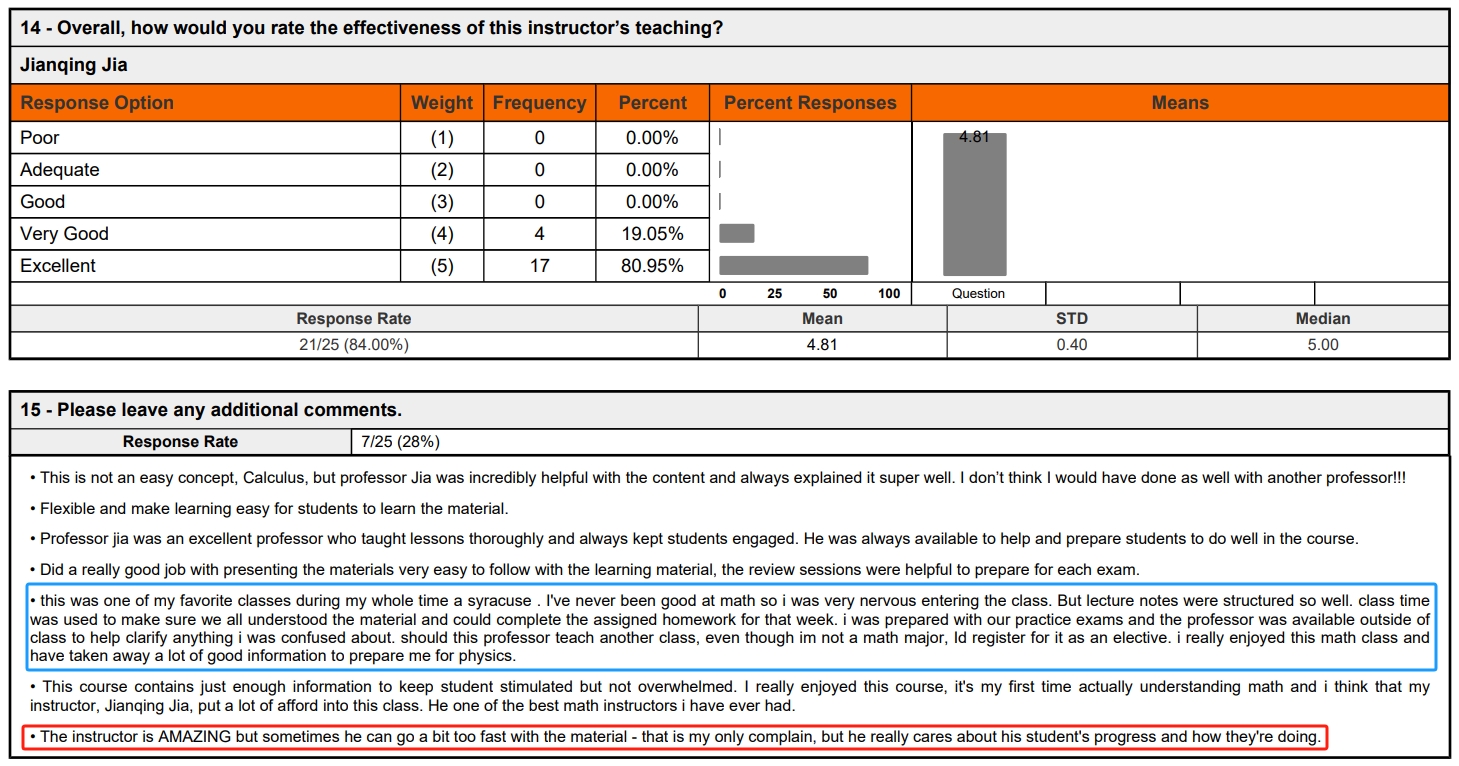
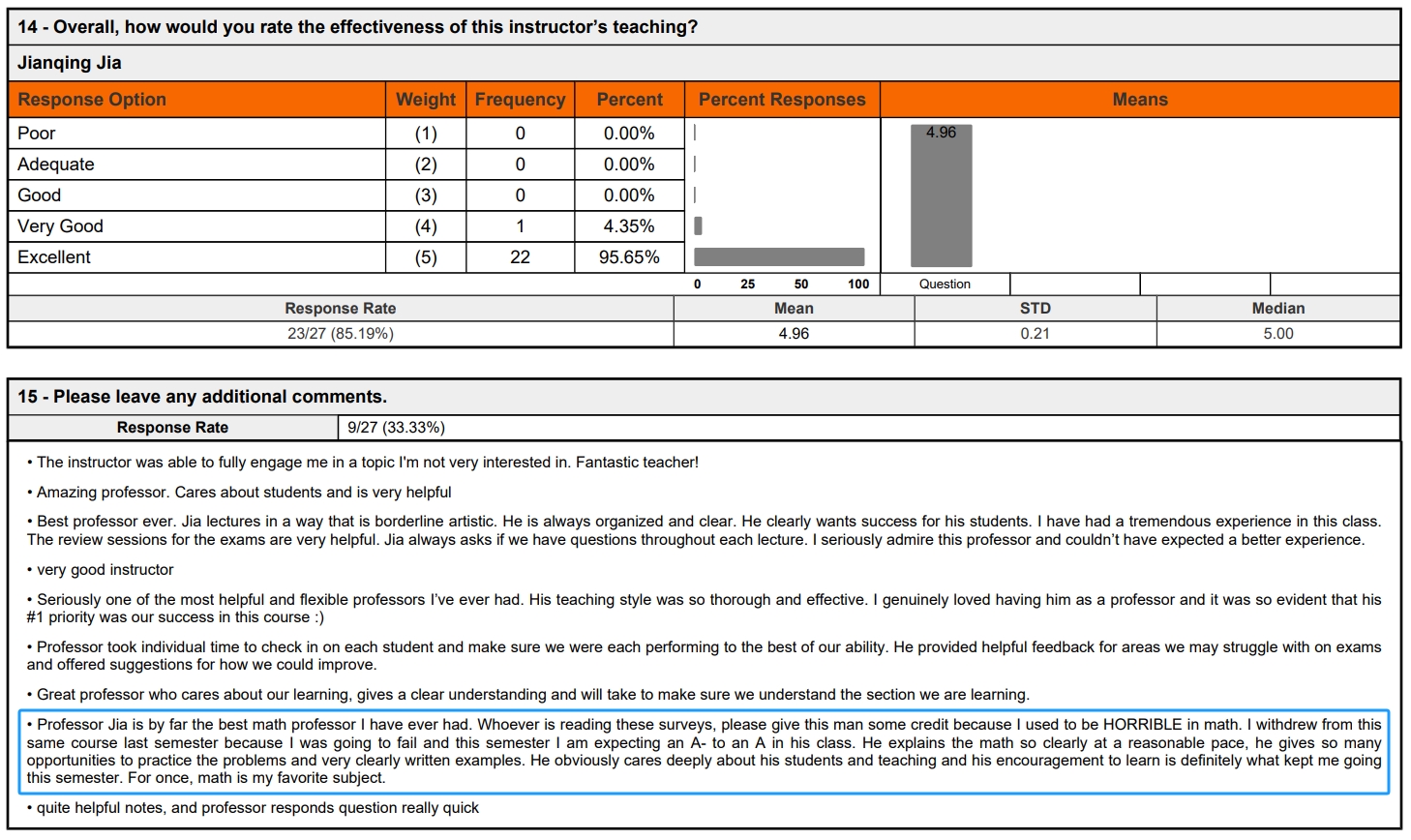
This semester, recognizing students' struggles with WeBWork, I began illustrating similar homework problems in class, specifically focusing on the correct insertion of mathematical formulas and the crucial role of parentheses. Additionally, I created homework hint documents, advising students to attempt problems on their own before consulting these aids. This approach appears effective, as evidenced by the absence of WeBWork complaints in this semester's evaluations. Reflecting on my growth, I now understand that while I can't change the system, I can change how I assist students, embracing the idea, "If you cannot change the world, change the way you see it."
I'm truly heartened to see my teaching effectiveness rating improve. In one of the sections, an overwhelming majority, 22 out of 23 students, rated me as "Excellent." This feedback is incredibly motivating and affirming.
Spring 2023: MAT 285 Life Sciences Calculus I
For my third time teaching MAT 285, I infused additional energy into supporting students who struggle with math. This proactive engagement, particularly after noticing some students had previously failed, demonstrates a commitment to their success. I proactively reached out to them, inquiring about their comfort with the course material and their preferences for pacing. Additionally, if a student missed a lecture without explanation, I would follow up to ensure everything was alright, demonstrating my commitment to their success and well-being.
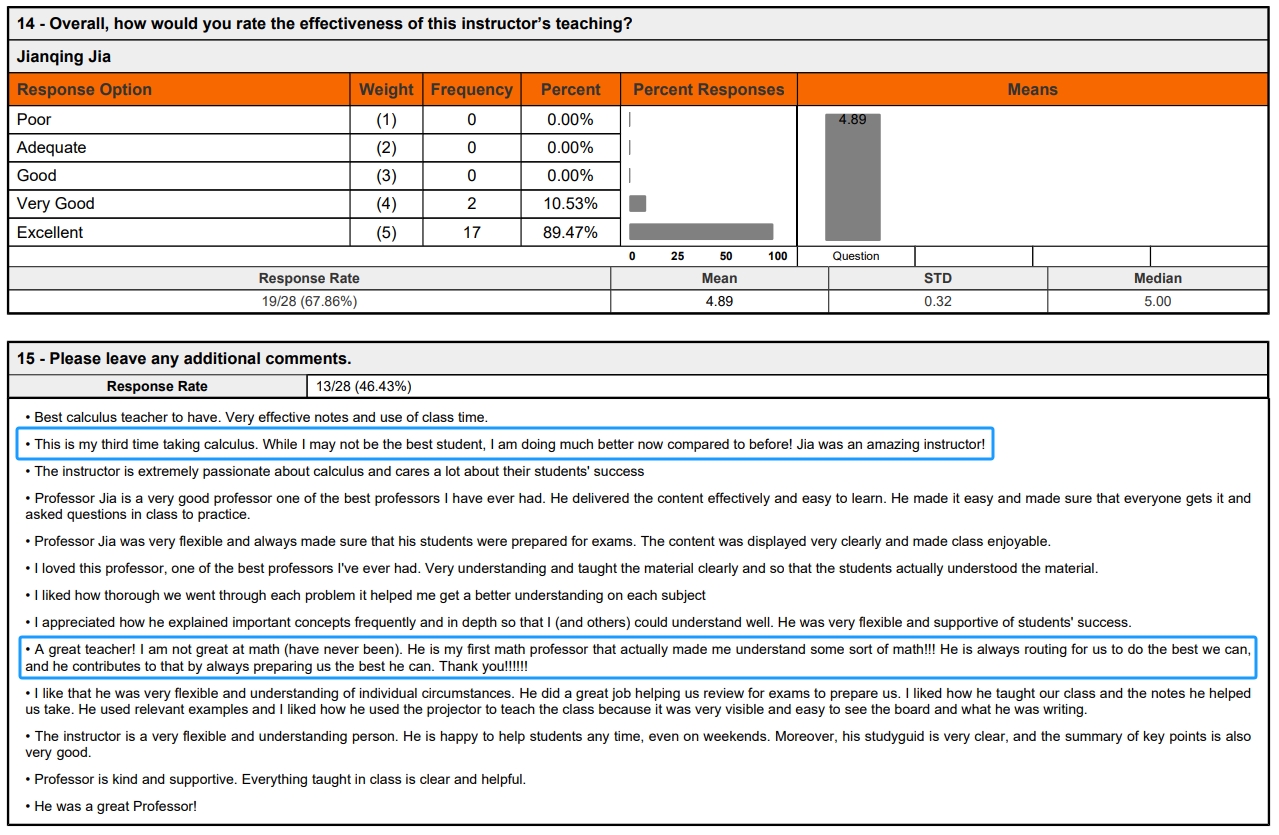
After reviewing the evaluations, it's clear that students recognize and appreciate my efforts to support and motivate them in math. Many, previously struggling with the subject, expressed newfound comprehension and success in their evaluations. Particularly gratifying was witnessing students, who had repeatedly failed before, excel in my class. Observing their growth and improvement has been incredibly rewarding.
Fall 2023: MAT 285 Life Sciences Calculus I
Having taught this class multiple times, my confidence has grown significantly. I've observed each set of lecture notes, quizzes, and exams evolving and improving over time, enhancing the learning experience for each new cohort of students.
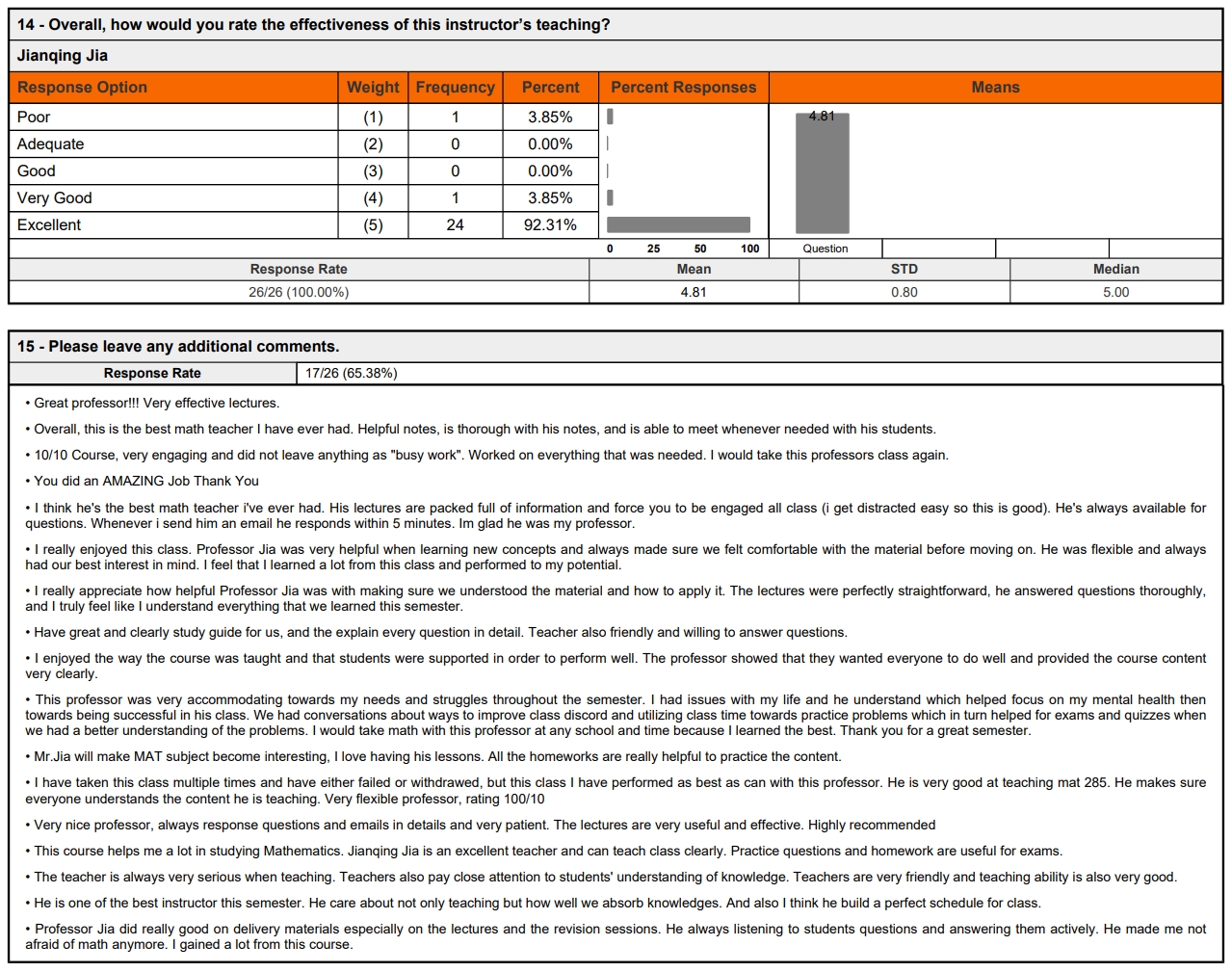
Based on the feedback, it appears that my teaching methods have positively resonated with the students. All of them engaged in the course evaluation, with a significant majority rating my performance as "Excellent." Interestingly, one student's rating seemed inconsistent, likely a misselection, given their otherwise high ratings. It's truly heartwarming to witness the determination of students who, despite previous setbacks, choose to re-engage with the material under my guidance. One such student, previously receiving an 'F', opted to retake MAT 285 in Spring 2024, believing in their best performance in my class after multiple attempts.

While there might be a touch of bias, I was pleasantly surprised to discover that some of my students had created a profile for me on Rate My Professor(click here), where they gave me full scores. This unexpected gesture speaks volumes about their appreciation and the impact of our shared educational experiences.
As I said in my teaching philosophy, this teaching journey reflecting the reciprocal nature of education: while my students learn from me, they concurrently shape me into a better educator. This ongoing journey continuously enriches my evolving teaching philosophy. Beyond merely imparting knowledge, my role extends to mentoring students to become lifelong learners, equipping them with the skills and confidence necessary to navigate our complex world with curiosity, enthusiasm, and resilience.